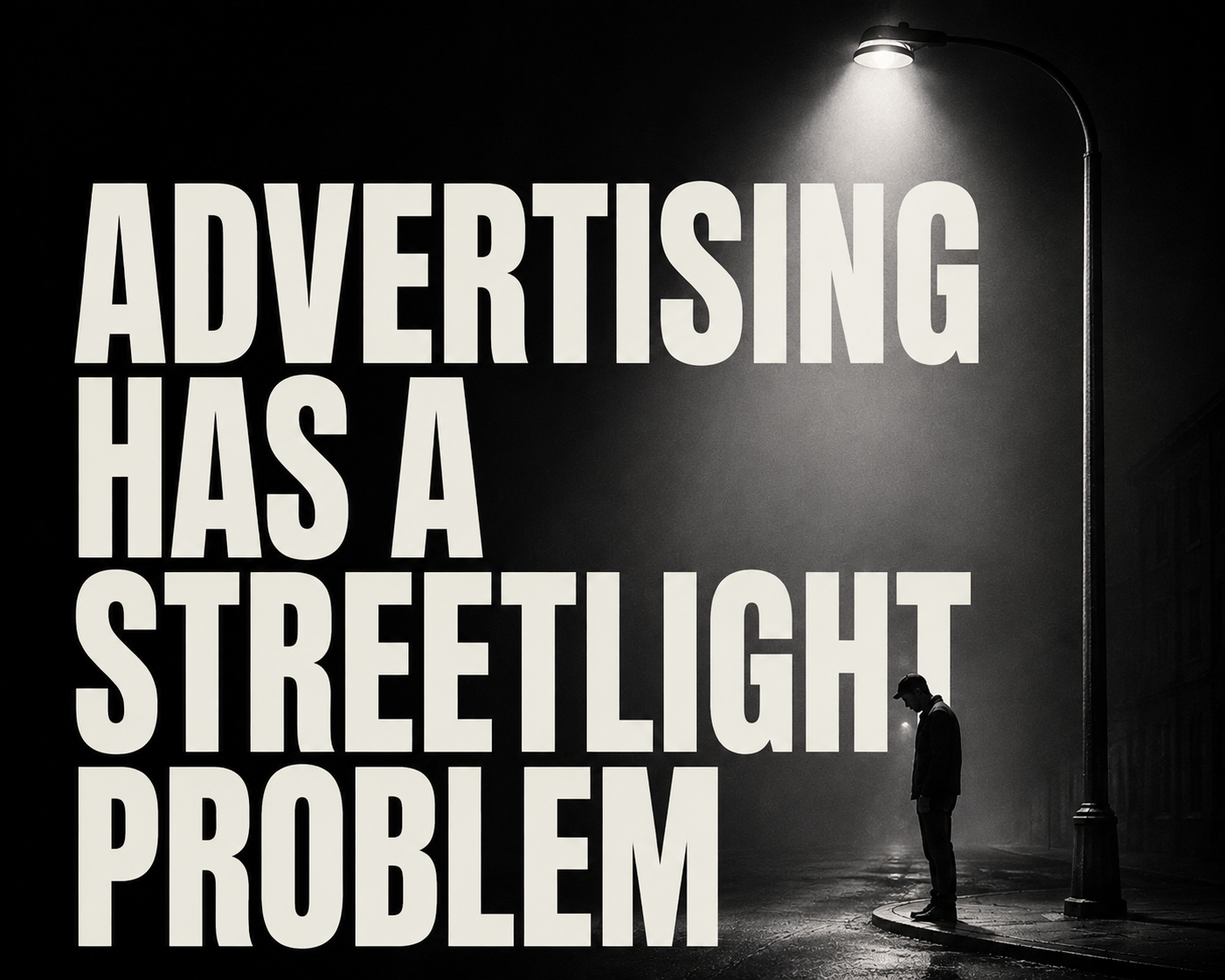
Ever heard the one about the drunk under the streetlight?
A cop spots a drunk searching for his wallet under a streetlight. He helps the guy look for nearly ten minutes before asking, “You sure this is where you dropped it?”
“Nope, I dropped it in the alleyway,” says the drunk. “But the light’s much better over here.”
…Okay, so it’s not much of a joke.
It’s interesting, though, because it neatly reveals an observational bias sociologists call the Streetlight Effect: The tendency to study problems using the data that’s easiest to measure while overlooking variables that are more important but harder to quantify.
If you’re in the business of making claims about reality through data and measurement, the Streetlight Effect is an elephant in the room.
Advertising has always had a Streetlight problem. We use data to decide what to make, figure out if it was successful, and then decide what to make next. So we’d better understand what that data actually reveals—and what it doesn’t.
Wrestling with this problem is a large part of a strategist’s job. And we got pretty good at it. Agencies were structured so that different disciplines challenged one another and teased out the complex, hidden variables. The dance between the dark places and the light ones made the work better.
And then a funny thing happened.
The internet arrived, and digital platforms accumulated billions of eyeballs—and billions of investor dollars. Finding themselves in need of a business model to monetize all that attention, they leaned into their strengths: They measured an astonishing number of things and then packaged those measurements into advertising products.
Before long, one particular kind of data became obscenely abundant: the stuff the digital platforms could measure. Metrics erupted like alphabet soup across our decks and dashboards: likes, clicks, CPVs, CVRs, VCRs, CPAs, CTRs, CPCs, ROAS.
I’ve got nothing against these numbers; we can learn a lot from them. The problem is, they’re so easy to come by—and so convenient to use as a measure of success or failure—that it has become much harder to justify spending time and money pursuing other things that are vitally important but harder to measure.
In effect, the platforms pulled off a colossal sleight of hand: They got us to confuse what was easiest to measure with what mattered most. The streetlights quickly became scoreboards. The consequences are still playing out.
They got us to confuse what was easiest to measure with what mattered most.
It hasn’t stopped at performance marketing. The whole industry has started reorganizing itself around what can be tracked. Media is moving closer to the center. Long-term brand building is becoming harder to defend against short-term performance. Agencies are being consolidated, disciplines disaggregated, and everything increasingly judged by its proximity to an immediately measurable outcome.
Which would all be fine, except advertising ultimately exists to do something notoriously hard to measure: make people want things.
And want is weird.
It’s all tangled up with memory, status, identity, habit, aspiration, culture, insecurity, belonging—all sorts of opaque forces that don’t announce themselves, much less line up neatly in a dashboard.
We can easily measure what someone clicked. How many seconds they watched something. What they engaged with. Sometimes, what happened next. (It’s worth remembering that the platforms have all but admitted their algorithms are designed to pay-off on negative emotions.) But these actions don’t tell you whether someone identifies with what a brand stands for, thinks of it first eight months from now, or has slowly accumulated the mental residue that will shape some future decision.
Those effects build over time, across channels, IRL interactions, culture, memory, and experience. They are the wallet in the dark alley.
None of this is an argument for switching off the streetlight. It means remembering what its light can—and can’t—show us, and for spending some time groping around in the dark. Because if the wallet is in the alley, measuring the sidewalk more precisely won’t help us find it.